How to read this platform
VUCA News doesn't track articles — it tracks Dynamics: persistent geopolitical situations that evolve over months or years. Everything on screen answers one of five questions: what changed, why, who is involved, what happens next, and how confident we are.
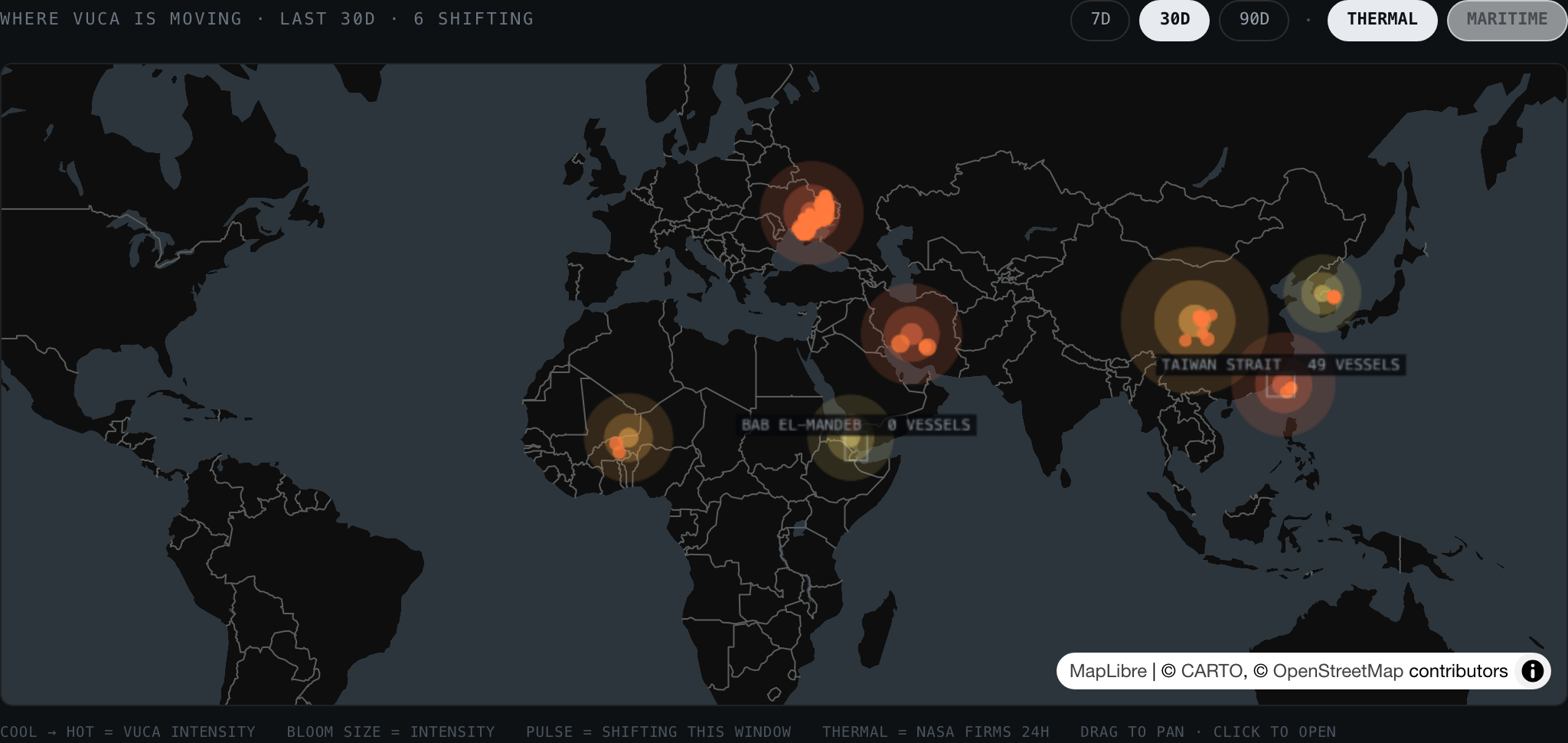
Each glowing bloom is one Dynamic. Color runs cool → hot with VUCA intensity, size scales with intensity, and a pulse means the situation shifted materially in the selected window (7D / 30D / 90D). Drag to pan, scroll to zoom, click a bloom to open its dossier. Two evidence layers can be toggled on: THERMAL shows actual satellite fire detections from the last 24 hours (NASA FIRMS), and MARITIME outlines the ship-traffic corridors we monitor, with today's vessel counts. Every dossier also carries its own theater mapwith toggleable layers — energy and military infrastructure, submarine cables, and KEY SITES: the curated geography that makes each situation legible (mineral deposits and refineries, nuclear facilities, launch sites, disputed dams, grain ports), plus live USGS earthquakes and GDACS disaster alerts where they fall in-theater.
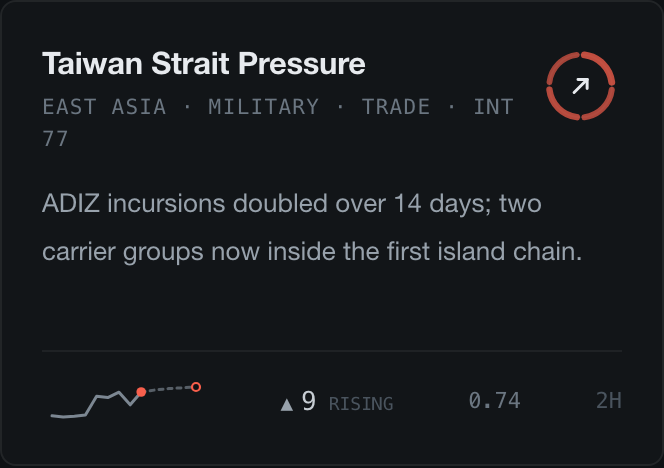
Every situation card carries the ring — the platform's signature glyph. Its four arcs are Volatility, Uncertainty, Complexity, and Ambiguity (clockwise from top); heavier, more opaque arcs mean higher component scores. Arc color encodes overall intensity, the center arrow shows trajectory (↗ rising · → steady · ↘ easing), and a faded ring means our confidence in the estimate is lower. Below the headline, the sparkline shows 90 days observed plus a dashed near-term forecast.
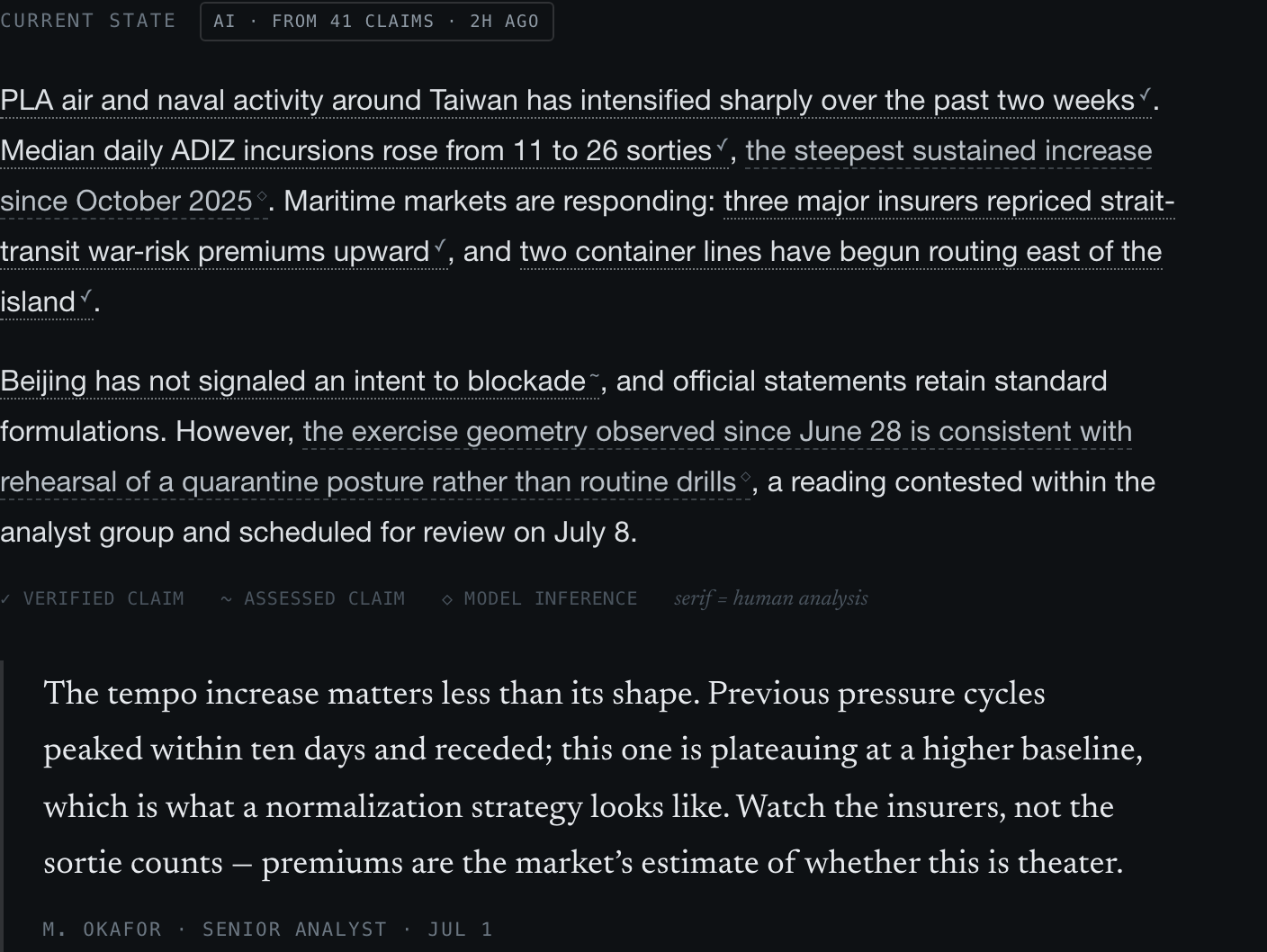
A dossier reads top to bottom in order of trust and depth: the 10-second header (index dial, trajectory, confidence) → what changed in the last 72 hours → intensity vs. its own 90-day baseline → the four VUCA components → the narrative → timeline → claims → forecasts → raw signal. Every sentence in the narrative is classed: dotted underline = an evidence-backed claim (click it), ✓ verified · ~ assessed, ◇ = model inference, and serif type is always a human analyst speaking.
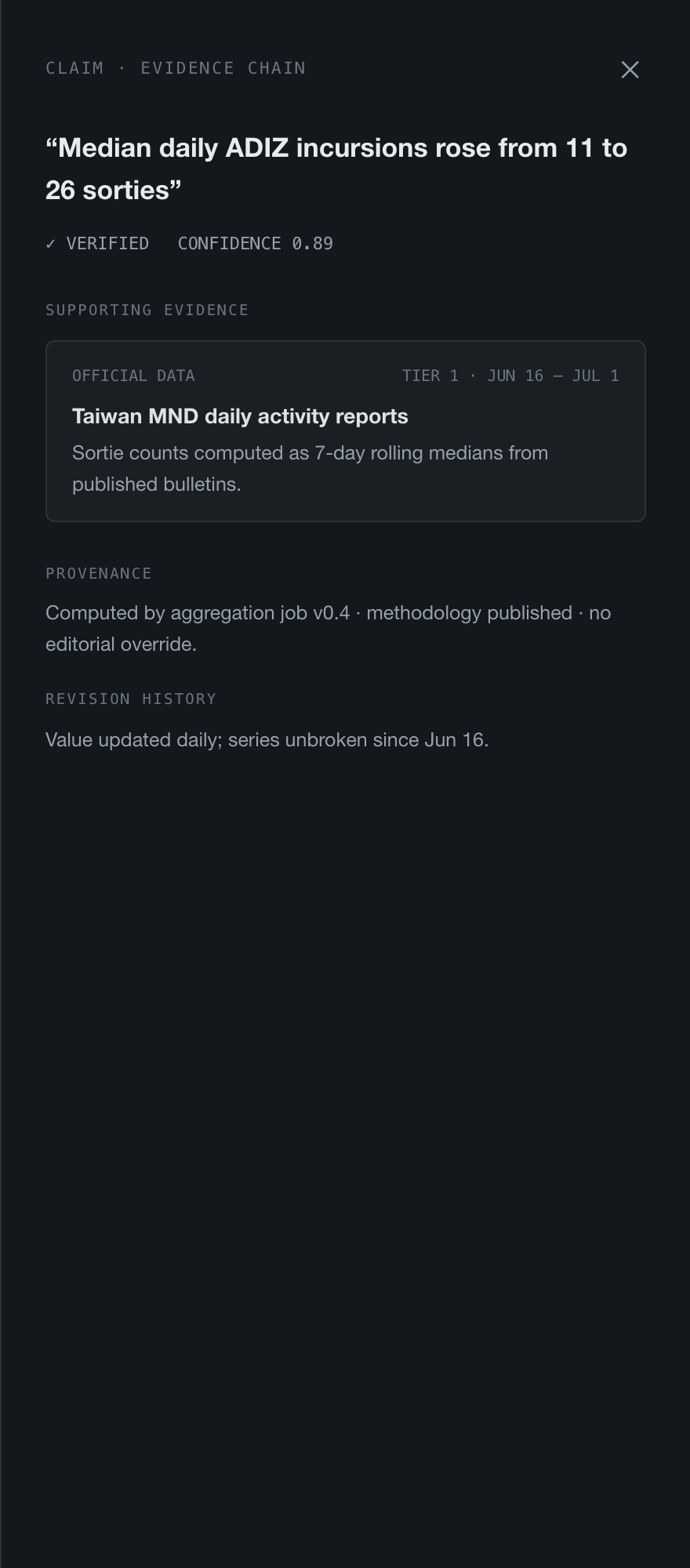
Click any claim — in the narrative, the claims matrix, or search — and the evidence chain opens: every supporting item with its source tier (TIER 1 = primary/official, 2 = independent reporting or imagery, 3 = secondary), the provenance record of how the claim was produced, and its confidence revision history. The confidence number (0–1) reflects sourcing quality; claims marked ASSESSED are supported but not primary-source verified. Some claims carry SATELLITE THERMAL evidence — automatic corroboration from fire-detecting satellites near the claimed place and time.
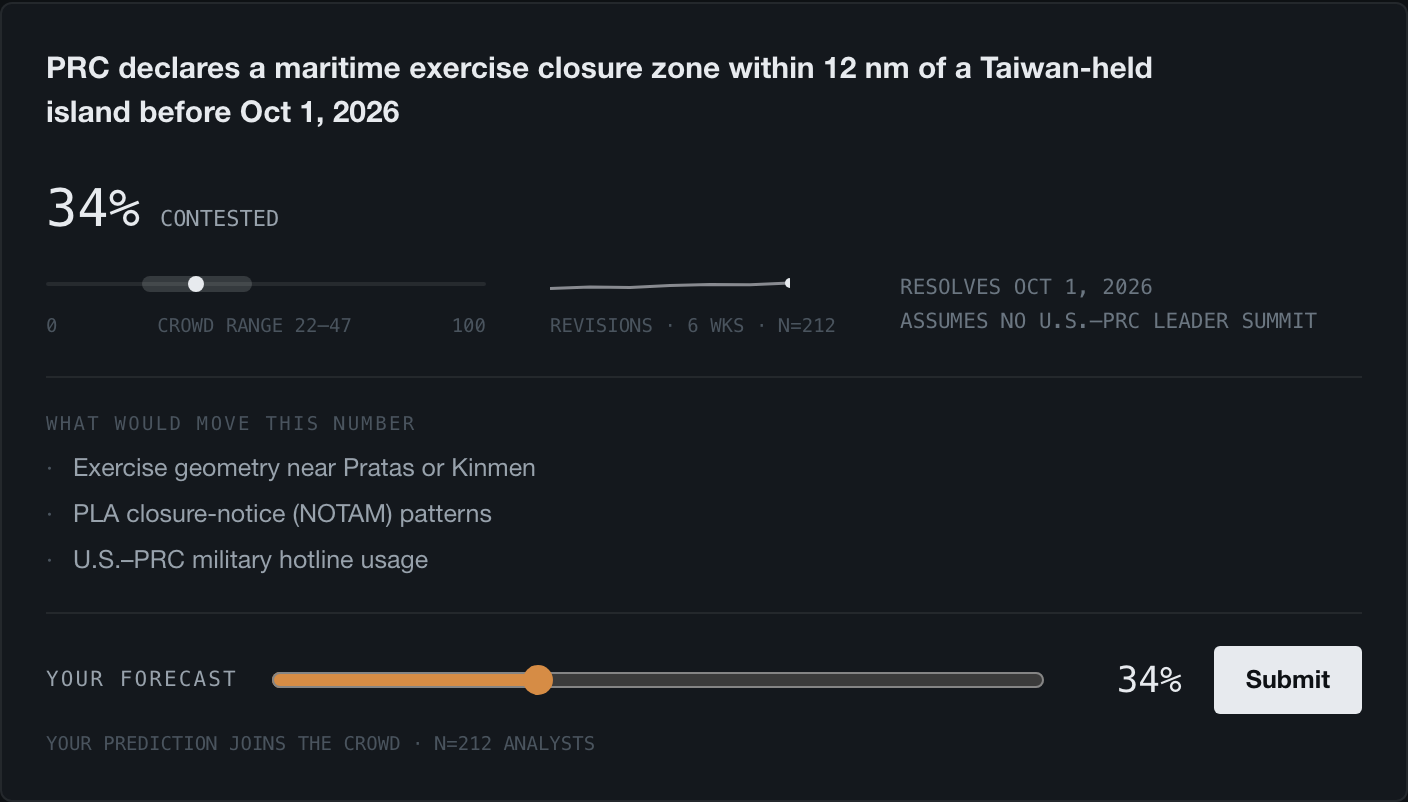
Forecast questions resolve against explicit criteria by a fixed date. The big number is the crowd's aggregate probability; the band is the crowd range; the small chart shows weekly revisions. “What would move this number” lists the leading indicators to watch — forecasts here explain themselves or they don't ship. Drag the slider to add your own forecast; your mark (in orange) joins the crowd.
Situations lists everything we track, shelved by category (conflict, resources, economy, science & technology, health, information, society & elections) — with the gaps we haven't covered yet stated honestly. People ranks the fifty most influential figures by current leverage, with corpus-derived “what they're up to” evidence. Elections carries the votes that move the world — stakes, contenders, and forecast-backed predicted outcomes. Divergence is the Contested Reality Index: where worldviews disagree hardest about what is actually happening. Situation Room puts the whole model on one full-screen board — top movers, the world map, chokepoint status, contested reality, the latest published claims, and forecast watch — refreshing itself every three minutes. Open it on a spare monitor and leave it running. Kiosk mode: add ?category=conflict (or resources, economy, science, health, information, society) to scope the whole wall to one shelf.
Downstream effects — what this situation touches, as mechanisms with falsifiable watch-indicators; THIRD-ORDER chips mark chains that propagate through another tracked situation. Narrative sentiment — how coverage sounds, measured daily with an open lexicon (tone, not truth). Public attention — Google search interest, so you can see whether the world is tuning in or out. Chokepoint monitor — actual daily transits through Hormuz, Suez, Bab el-Mandeb, the Bosporus and more (IMF PortWatch), with our own live AIS sample beside it. Displacement — refugees abroad and the internally displaced per theater country: UNHCR/IDMC annual stocks plus IOM DTM operational rounds where DTM runs, with year-over-year change. US travel advisories — Washington's official risk level (1–4) for the countries in the theater, stamped with State's own update date and change note — a deliberate policy signal, labeled as a US-government perspective. Distant-water fleet — measured fishing effort per hotspot region and at-sea transshipment encounters (Global Fishing Watch). Conflict-event counts (UCDP), oil prices and producer output (EIA), and strategic trade flows (UN Comtrade) feed the analysts and the effects watchman as slow series. Each panel states exactly what it measures and what it doesn't.
Signed-in readers can act on the record. On any claim: Challenge (say what's wrong, with a source link — accepted challenges earn public credit on the claim's revision history) or Evidence (attach a corroborating or complicating link). On any forecast: Reasoning — argue your probability, but only after you've logged your own (arguments stay locked until then, so they can't anchor you). Everything is rate-limited and desk-moderated.
Everything on this site is available as JSON — free with attribution: situations, point-in-time score history (append-only, never revised), the divergence index, claims with their evidence chains, source ledgers, and the live AIS vessel sample per monitored corridor (samples, not a census — the payload says so). The engine also audits itself in public: the replay-calibration receipts on /methodology recompute the entire published record with current formulas. See /api/docs for endpoints, or embed live widgets from /embeds.
Press ⌘K (or Ctrl K) anywhere to search situations, entities, and claims — claim results deep-link straight into their evidence drawer. Esc closes any panel. Entity pages (via search or any entity chip) show what an actor participates in, its relationships, and recent claims about it — everything connects, and nothing is a dead end.
Ingestion pulls from registered sources (UN OCHA ReliefWeb, official feeds, monitored outlets, GDELT, USGS seismic, ship-traffic telemetry) around the clock. Claims are machine-extracted with a grounding quote, adversarially reviewed by AI, and approved by a human editor before publication — with one narrow, labeled exception: tier-1-source claims that pass verification cleanly at high confidence may auto-publish under a server-enforced policy (see /standards). VUCA scores are computed daily by a transparent formula over these signals — every score can explain itself, down to the feature values that produced it.